Eddie Cohanim
AI Engineer with a B.Sc. in Mathematics and Computer Science from the Technion (2x Dean's List). Experienced in production computer vision pipelines, MLOps orchestration on GCP/Modal, and building end-to-end autonomous agents.
Who am I?
AI Engineer and SW Developer at Constrol with a B.Sc. in Mathematics and Computer Science from the Technion. Analytical, self-motivated professional with a sharp problem-solving mindset, excellent communication, and strong interpersonal skills. A fast learner who thrives in collaborative, high-performance environments, dedicated to delivering meaningful impact through innovative AI solutions.
Languages
- English - Native speaker
- Hebrew - Native speaker
Experience
AI Engineer and SW Developer
September 2025 - PresentConstrol
Developed computer vision pipelines that turn architectural blueprints into 3D building models, in a six-person R&D team working closely with civil engineers and annotators, and optimized their stages from pre-processing to inference.
Room identification
Built the production chain that turns an architectural and a structural floor plan into enclosed, typed rooms.
Graph-based room detection
The pipeline detects both drawings, aligns the architectural plan onto the structural one, and then applies graph theory: walls and openings are defined as edges and their intersections as vertices, and every loop in the graph that contains no smaller loop is identified as a room.
Tiling for full-sheet inference
A full sheet at 400 DPI is orders of magnitude larger than YOLO's native 640 input, so each page is cut into tiles, predicted, and merged back to page level.
Overlapping tiles
Tiles overlap by 20% so an opening cut by a tile edge still appears whole in the neighboring tile.
Larger tiles for more context
Proposed raising the tile and training size from 640 to 1280 after realizing that too much context from the surrounding area was lost at 640. The larger tiles gave the model the context a blueprint needs to be read, improving detection results by about 5%.
Opening detection models
Trained YOLO11 Large models using both polygons and oriented bounding boxes (OBBs) to separate nine opening types on architectural drawings: door, window, sliding door, mamad (safe room) door, mamad window, laundry-niche window, ventilation, opening location, and element mark.
Hyperparameter tuning
Tuned training for technical drawings to improve results, covering the learning rate, augmentations, image size, optimizers, filtering, and the use of background annotations.
Datasets and annotation
Managed the dataset in both V7 Darwin and Label Studio, while overseeing that annotations were done correctly and accurately to ensure correct training.
Pipeline performance optimization
Improved pipeline performance by parallelizing workloads, replacing bottleneck Python routines with inline C extensions, and migrating to GPU-accelerated libraries that fully utilized available hardware.
Engineered an end-to-end autonomous agent tailored to internal R&D workflows, orchestrating multi-step blueprint validation and spatial triage via OpenAI GPT tool-calling and structured outputs.
On my own initiative, built a comparison tool that checks the pipeline's output against the modeler's ground-truth IFC/RVT model. It made the testing phase streamlined and scalable, giving a better improvement curve and fewer bugs reaching production.
One-to-one matching
The tool registers the two models and matches walls and openings one to one.
Metrics report
The tool reports what matched, what deviates, what the pipeline added, and what it missed as metrics.
Overlay visualization
Created a visualization that overlays the two models, making the review process faster and easier.
Built the serving, versioning, and release infrastructure for the detection models behind the batch model-generation app.
Serving
Models are served by the detection pipeline on Modal by default (an L4 GPU that scales to zero), or on a single GPU VM or GKE when a long-running cluster is needed.
Weight versioning and promotion
Weights are versioned in GCS, hot-reloaded without rebuilding the image, and promoted from staging to production with rollback.
Experiment tracking
Training runs are logged in Weights & Biases, including resumed runs and per-class metrics.
Owned a key product vertical, working with civil engineers and annotators to align AI constraints with real engineering requirements, and built interactive demos to show its capabilities to stakeholders.
Projects
This Website
Designed and built this full-stack, single-page website using Next.js 16 (App Router) and TypeScript, hosted on Vercel with continuous deployment from GitHub.
Integrated an AI-powered chatbot that streams Anthropic Claude Haiku 4.5 replies through the Anthropic TypeScript SDK into a Vercel AI SDK chat interface, enabling visitors to interactively ask questions about my background and experience.
Used Claude Code throughout the build to architect features, write and review code, run static checks, and manage deployments, extended with MCP servers such as Playwright for in-browser testing. Worked on a feature-branch Git workflow with TypeScript type checking on every push and security audits through custom slash-command skills.
Designed a blueprint-inspired visual identity: the hero name draws itself as construction lines, an outline, and a 3D extrusion over a drafting grid, alongside a particle canvas with a spring-animated cursor glow and a sliding navigation indicator, all tuned for light and dark themes.
Legit - AI News Credibility Verifier (Technion CS Hackathon Finalist 2025, Mentor 2026)
Led a 4-person team that built a Chrome extension using large language models to scan news articles in real time and flag potential misinformation, reaching the hackathon finals. The team then developed the prototype into a complete product, published on the Chrome Web Store for all major Chromium-based browsers.
Co-built a multi-agent system in which specialized agents analyze each article in parallel.
Credibility scoring
Six agents (source verification, author credibility, fact-checking, bias detection, writing quality, and headline accuracy) each contribute a weighted score to a final 0-100 credibility rating.
Smart Context Search (SIFT)
Search agents look for independent coverage of the article's claims, surfacing supporting and contradicting sources for lateral reading.
Co-built a feature that uses Levenshtein distance to locate and highlight suspicious claims directly in the article, even when the formatting differs from the quoted text.
Beer and Wine Image Classifier
Co-built a two-stage computer vision system classifying beer and wine types from images: a YOLO11 object detection model for bounding-box localization, followed by a custom CNN classifier on the cropped regions.
Configurable CNN from scratch
Co-implemented the CNN architecture from scratch in PyTorch, with a fully configurable feature extractor (conv layers, batch norm, pooling, activation) and classifier head (fully-connected layers, dropout), all driven by a single config.json file with no hardcoded hyperparameters.
Built the data pipeline from raw image collection through augmentation during training.
End-to-end dataset construction
Constructed and curated the dataset end-to-end: collected and organized raw images, wrote a dataset splitting pipeline, and built a preprocessing pipeline with validation reporting to ensure structural integrity before training.
GPU-accelerated augmentation
Designed a GPU-accelerated augmentation pipeline using Kornia (random flips, rotations, color jitter, Gaussian blur, perspective distortion, gamma correction) applied inline during training for effective data expansion without storing augmented copies to disk.
Tuned the model across tracked experiments and measured it against published results.
Hyperparameter research
Conducted extensive hyperparameter research across multiple tracked experiment versions, tuning learning rate, weight decay, batch size, channel depth, dropout, pooling type, early stopping patience, and optimizer (Adam, AdamW, SGD).
Benchmarking against published work
Researched and benchmarked results against published papers and pretrained models, evaluating per-class precision, recall, F1, and confidence scores.
Education
B.Sc. in Mathematics and Computer Science
October 2022 - April 2026Technion - Israel Institute of Technology
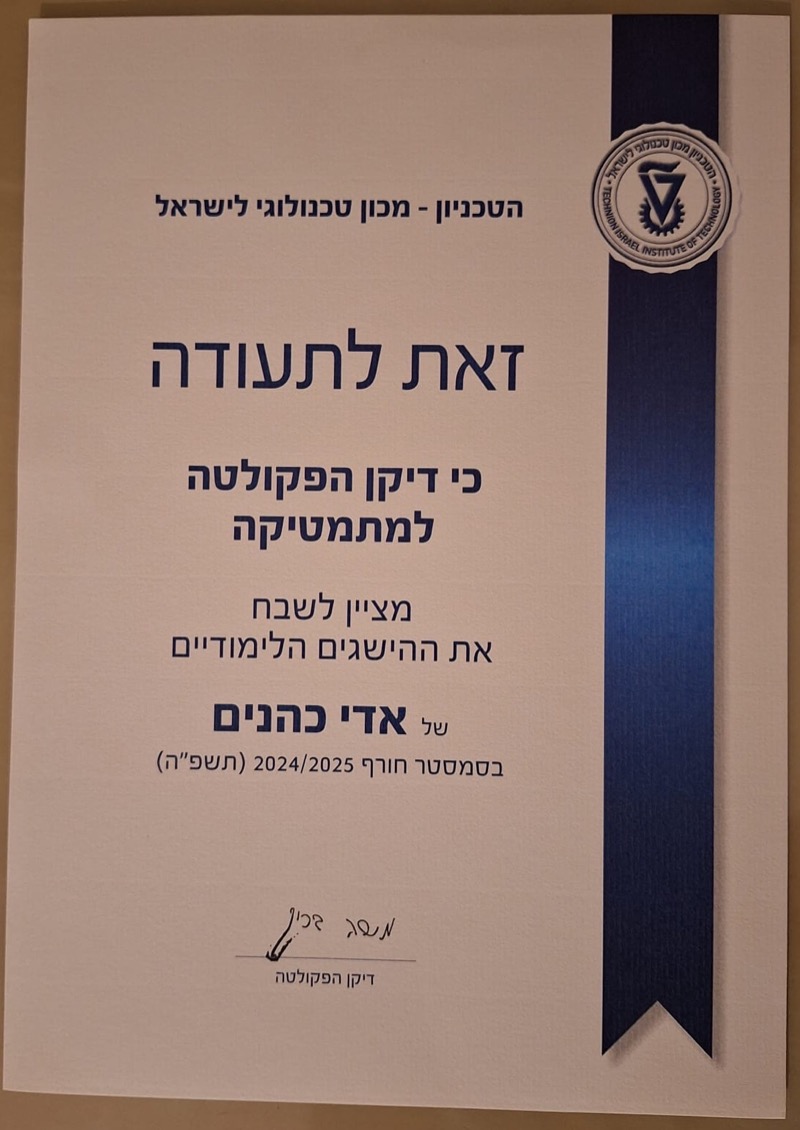
Awarded for academic excellence and maintaining a high GPA.
Awarded for academic excellence and maintaining a high GPA.
Graduated with a B.Sc. in Mathematics and Computer Science from the Technion.
AI, Deep Learning, Data Structures, OS, Computer Organization and Programming, Algorithms, and Computer Structure.


Hackathons
Technion CS Hackathon
2025Participant - Finalist
Led a 4-person team that built Legit, a Chrome extension that uses large language models to scan news articles in real time and flag potential misinformation, earning a finalist placement among all competing teams.
Technion CS Hackathon
2026Mentor
Returned the following year as a mentor, supporting the participating teams throughout the hackathon.
Skills
Programming Languages
- Python
- C++
- C
- Bash
- Assembly
AI/ML & Infrastructure
- PyTorch
- YOLO
- Kornia
- Weights & Biases
- GCP (GKE, GCS)
- Modal
- Linux
- Git
Fields of Knowledge
- AI
- Deep Learning
- Data Structures
- OS (multi-threading, multi-processing)
- Algorithms
- OOP
Military Service
Infantry, IDF Reserves
November 2020 - PresentServed on active reserve duty during the war that began on October 7, 2023.
Staff Sergeant, IDF Nahal Brigade
March 2018 - November 2020Led over 40 soldiers and managed platoon operations and logistics in high-risk combat environments.
Recommendations
Dror Lederman
Head of AI, Constrol
Available as a reference on request. Get in touch and I will put you in contact.